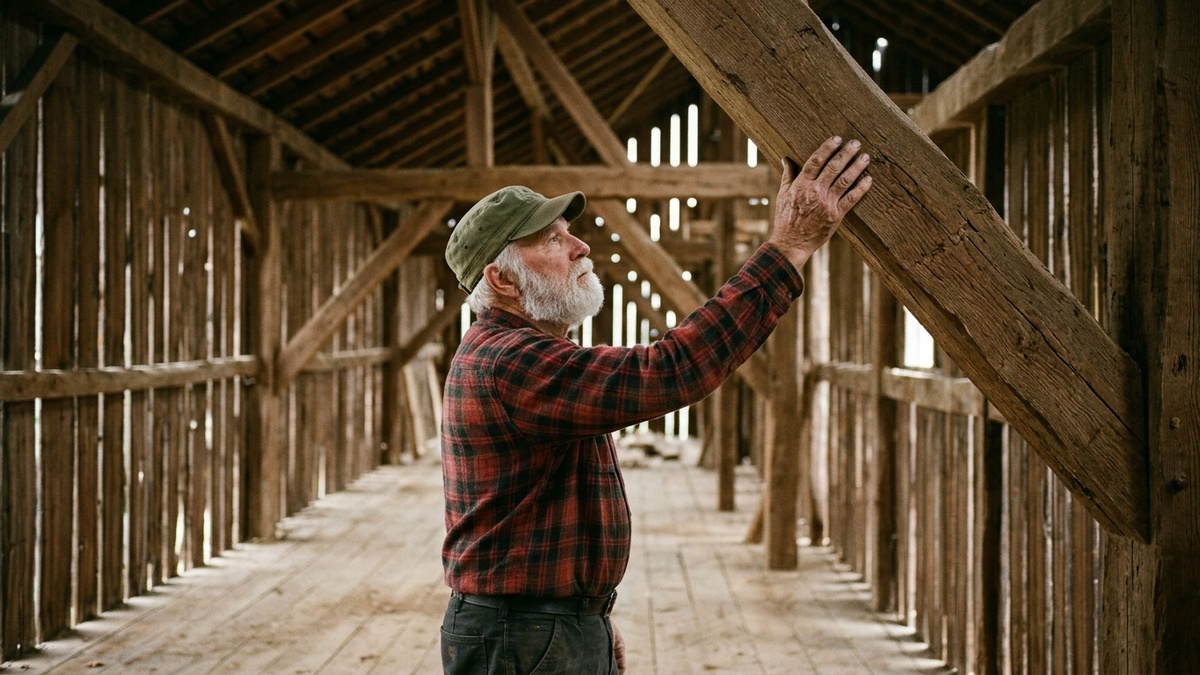
According to Owen Hale, age five, a ghost in boots crossed the ceiling of his daddy's new wedding barn every night at ten o'clock sharp.
Walt was on his knees in the lane they shared, fixing the culvert, when the boy came down with his gray kitten under one arm. Biscuit, Walt's old beagle, got up and sniffed the kitten. The kitten sneezed.
"What kind of ghost?" Walt asked.
"The walking kind. It goes clomp, clomp, clomp. Across the ceiling." Owen pointed up the hill at the barn. "Mommy says it's the wind. Daddy says it's the barn settling. But it's a ghost."
Walt looked up at the barn for a long moment.
"What time, did you say?"
"Ten o'clock. After my bedtime." Owen lowered his voice. "I sneak."
Brandon Hale had bought the farm next to Walt's two years ago and moved out from Cincinnati with his wife, Jenna, and their boy. The old bank barn on the hill had come with it. It was a big barn, built around 1890, with hand-hewn oak beams and a stone foundation set into the hillside.
Brandon had spent everything he had turning it into a wedding venue. New floor, new windows, new lights. A long iron chandelier made from an old wagon wheel, hung from the middle of the main tie beam. The first wedding was booked for Saturday. A hundred and forty guests, a bride from Columbus, and a photographer coming down from Cleveland.
Walt had watched the work all summer from his own barn workshop down the lane. He had kept his opinions to himself. That was how he did most things. Measure twice, speak once.
That evening, after supper, he walked up the lane with a flashlight and knocked on the Hales' door.
"Brandon," he said. "I'd like to sit in your barn tonight, if that's all right. Around ten."
Brandon laughed. "Did Owen get to you too?"
"Maybe," Walt said.
They sat in folding chairs in the middle of the barn floor with the lights off. Biscuit lay at Walt's feet. The new floor smelled of polyurethane. Under it, Walt could smell the old wood, oak and dust and a hundred and thirty years of hay.
The night was clear and dropping fast toward freezing. At five minutes to ten, Walt heard the first sound.
Tock.
It came from above them, from the big tie beam that ran across the barn at the height of the loft. A pause. Then another, a foot or so farther along.
Tock. Tock.
Brandon sat forward. "That's it. That's what Owen hears."
Walt did not answer. He was listening with his whole body, the way he listened to a board when he planed it.
Tock. Tock. Tock.
It walked. That was the strange part. Each sound came a little farther along the beam, from the east wall toward the middle, toward the place where the chandelier hung. It sounded exactly like a man in boots crossing the loft very slowly.
"It's the cold," Brandon said. "The contractor said so. Old wood shrinks at night."
"Old wood shrinks," Walt said. "It doesn't walk."
The next morning, Walt brought his tallest ladder and climbed up to the tie beam.
He took his time. He ran his hand along the oak and smelled it. Near the east end, where the beam met its post, he found what he had been listening for. A fine crack, thin as a pencil line, running along the grain of the wood. It started at the old wooden peg that pinned the joint and ran nine feet toward the middle of the barn.
He took a feeler gauge out of his shirt pocket and slid it into the crack at the east end. Then he moved down the beam and tried again. The crack was widest near the post and narrowed toward the chandelier. But at the far end, it had a fresh, pale face, like a split log.
That was where it was growing.
Walt came down the ladder slowly.
"Brandon," he said, "that beam's splitting. Every night when it freezes, the oak pulls in and the crack opens another few inches. That's your footsteps. And it's walking straight toward that chandelier."
Brandon's face went still.
"The contractor said the beams were sound. He checked them in July."
"In July they were. That wagon wheel weighs four hundred pounds. You hung it in September." Walt wiped his hands on his jeans. "I wouldn't put a hundred and forty people under it Saturday."
Brandon called the contractor in Columbus. The contractor said he couldn't come until the following week. He said old barns make noises. He said the beam had been holding a hayloft for a hundred years.
Jenna called the bride. The bride cried. Her mother got on the phone and said they had paid the deposit in January and there was no other place in three counties with an open Saturday in December.
By Friday afternoon, Brandon looked like a man who had not slept in two days. He found Walt in his workshop.
"I've got everything I own in that barn," he said. "If I cancel, I'm done. Not one bride in Ohio is going to book a wedding barn that canceled its first wedding."
Walt set down his chisel.
"How big is your truck?"
"What?"
"There's a timber in the back of my barn," Walt said. "White oak. Twenty-two feet long. I've been saving it since 1998 for something that mattered."
They had the white oak on the Hales' barn floor by six. Pastor Sam Greer came up the lane at seven with a thermos of coffee and his old Marine Corps work gloves. Walt laid out his tools on a sawhorse in a straight row: chisels, the big auger, the come-along, and the long bolts he had bought in Marietta that afternoon.
At a quarter to ten, they had the scaffolding up and the new timber lifted halfway to the loft on a chain hoist.
The temperature was falling fast.
Walt was standing on the scaffold with his hand flat on the old beam when he felt it shiver under his palm.
Then the barn rang with a crack like a deer rifle, and hundred-year-old dust came sifting down through the lights onto a hundred and forty white tablecloths.