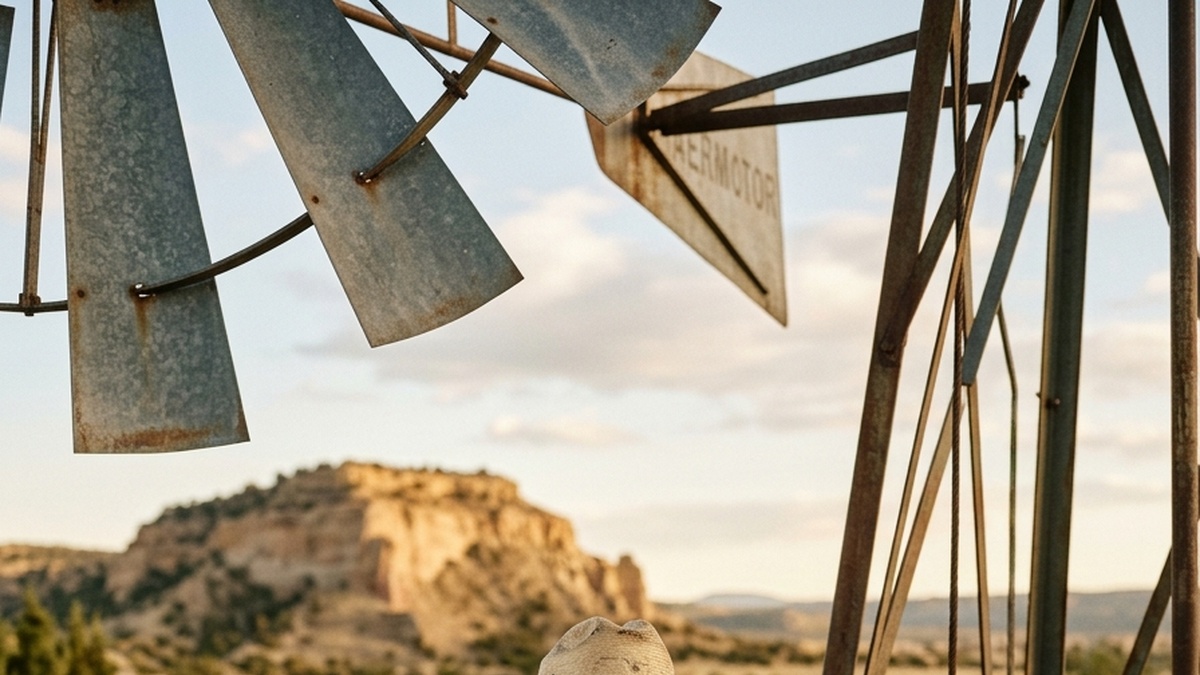
Piñon Wells ran out of water at two in the morning on the Tuesday before Thanksgiving, and by noon Neto Baca was staring at a windmill that had not turned since 1994.
The village well pump had burned out sometime after midnight. It was a big electric pump that sat four hundred feet down in a steel casing. The water association had called three companies in Albuquerque. The earliest any of them could bring a new pump and a crew was December eighth.
By noon, the school had sent the children home. The volunteer fire department had one tanker of water hauled in from Mountainair and no promise of a second. And Lupe Baca had taped a sign to the door of her café on old Highway 60. CLOSED. NO WATER. SORRY.
Thanksgiving week was the best week of her year. Hunters, travelers, families driving to grandma's. She did a third of her winter business in those six days.
Her grandfather sat at the counter of the closed café with a cup of coffee she had made from a jug of store water. He was looking out the window at the mesa above the arroyo.
"Abuelo," Lupe said. "Don't."
"I haven't said anything."
"You're looking at it."
The windmill stood on the mesa a half mile above town, a steel tower thirty feet tall with a wheel of curved blades at the top. Neto's father had drilled that well in 1938, by hand and with a borrowed rig, when Piñon Wells was a gas station, a church, and eleven houses. For fifty-six years, that windmill had been the village's only water.
In 1994, the county put in the electric well. The windmill was chained out of the wind and left to rust.
Neto had kept it greased anyway. Every spring, for thirty years, he drove up there and climbed the tower and oiled the gearbox. He had been a windmill man his whole working life. He had fixed windmills on ranches from the Rio Grande to the Texas line. There were fewer of them every year, and fewer men who knew how they worked.
He was seventy-eight now. He still squinted at the sky every morning to see what the wind was doing, the way some men check a watch.
"Wind's out of the west at fifteen," he told the window. "Good pumping wind."
Carla Ortega ran the water association. She came into the café at two with her phone in one hand and a legal pad in the other. She was fifty-two and looked as though she hadn't slept.
Neto told her his idea. Carla listened all the way through. Then she shook her head.
"Mr. Baca, I respect you," she said. "But that well hasn't pumped a drop in thirty years. The pipe could be rusted through. The rods could be rotten. And I am not putting a seventy-eight-year-old man on a thirty-foot tower."
"I don't need to climb. Mateo can climb. I need to stand at the bottom and tell him what to do."
Mateo was Lupe's son, fifteen and already taller than his great-grandfather. He looked up from his phone with great interest.
"Absolutely not," Lupe said.
Carla rubbed her eyes. "Last year, a retired fellow offered to fix the community center boiler for free. He flooded the basement. It cost us six thousand dollars and our insurance agent still won't return my calls." She looked at Neto. "I'm sorry. I'm not doing it again."
"Then the hunters drive on to the next town," Neto said gently. "And the fire truck has one tank. And the Archuleta cattle drink what the Archuletas can haul."
Carla did not answer for a long time.
"One day," she said finally. "And the state lab tests it before it goes in a single glass. It's for the fire tanker and the stock tanks and the school toilets. That's all."
"That's all I'm asking," Neto said.
He sent Lupe and Mateo to his shed that evening for what he needed.
Mateo came back with the tools in a wheelbarrow. Pipe wrenches, rod tongs, a coil of rope, a block and tackle. And a lard pail with a dozen round pump leathers inside, the size of saucers, stiff and brown.
"These look like old shoes," Mateo said.
"They are like old shoes. The leathers sit on the plunger at the bottom of the well. Every stroke, they push the water up the pipe. After a while, they wear out, like the soles of your boots." Neto filled the pail with water from the jug. "We soak them tonight so they swell up soft. Dry leather won't seal."
Mateo pointed at something else in the wheelbarrow. It was a strange iron thing, about two feet long, with a hollow mouth at one end and a pair of spring jaws inside it.
"What's this one?"
"My father made that," Neto said. "It's for fishing."
"Fishing for what?"
"For the day the rods go down the hole." Neto turned it over in his hands. "They always do, once."
They started at first light Wednesday. It was cold, and the wind had come up hard out of the west.
Mateo climbed the tower in a borrowed harness and set the brake on the wheel so it would not turn. Then they rigged the block and tackle to the top of the tower and began to pull the pump rod out of the well.
The rod came up in twenty-foot sections, joined by threaded couplings. Each time a coupling cleared the top of the pipe, Neto clamped the rod tongs on it, and Mateo and two of the Archuleta boys broke it loose with pipe wrenches. Neto stood at the wellhead with his hand on the rod and felt every section come up.
Nine sections. A hundred and eighty feet.
The plunger came up last, dripping. The old leathers on it were worn as thin as paper and split down the sides.
"That's your problem," Neto said. "Thirty years of nothing to do but dry out."
By two in the afternoon, the new leathers were on. They began lowering the rods back down. Section by section, coupling by coupling. Lupe brought sandwiches. A crowd of neighbors had come up the mesa road in their pickups to watch.
Carla's car pulled up at a quarter to four.
They were lowering the last section when Neto heard the coupling below it groan.
It was an old coupling, crusted with rust on the outside. He felt it in the rod before he heard it. A small, wrong click, like a knuckle popping.
"Hold it," he said. "Mateo, hold it."
The coupling let go.
The whole string of rods dropped down the pipe with a long, ringing rush of steel, falling a hundred and sixty feet into the dark. The sound went on and on, getting fainter. Then there was a dull thump far below, and then nothing.
Carla stepped out of her car in time to hear the last of it, and stood staring at the open pipe as if it had just swallowed the whole village.